 by Dr. Sneha Dholakiya
 16 July 2026
Introduction
A misplaced sample label. A manual entry typo. A slightly delayed reading on a fragile test. In traditional pathology labs, small human mistakes like these have always been the hidden risk behind every report. They rarely make headlines, but for a patient waiting on results, even a small error can mean a wrong diagnosis or a repeated test.
This is the exact problem that lab automation was built to solve. Over the last decade, diagnostic labs across India have moved from manual, technician heavy workflows to systems where machines handle sample sorting, testing, and result verification with minimal human touch.
In this article, we will look at how automated diagnostic testing actually works, why it matters for accuracy, and what patients in Ahmedabad should look for when choosing an automated pathology lab.
What Is Lab Automation
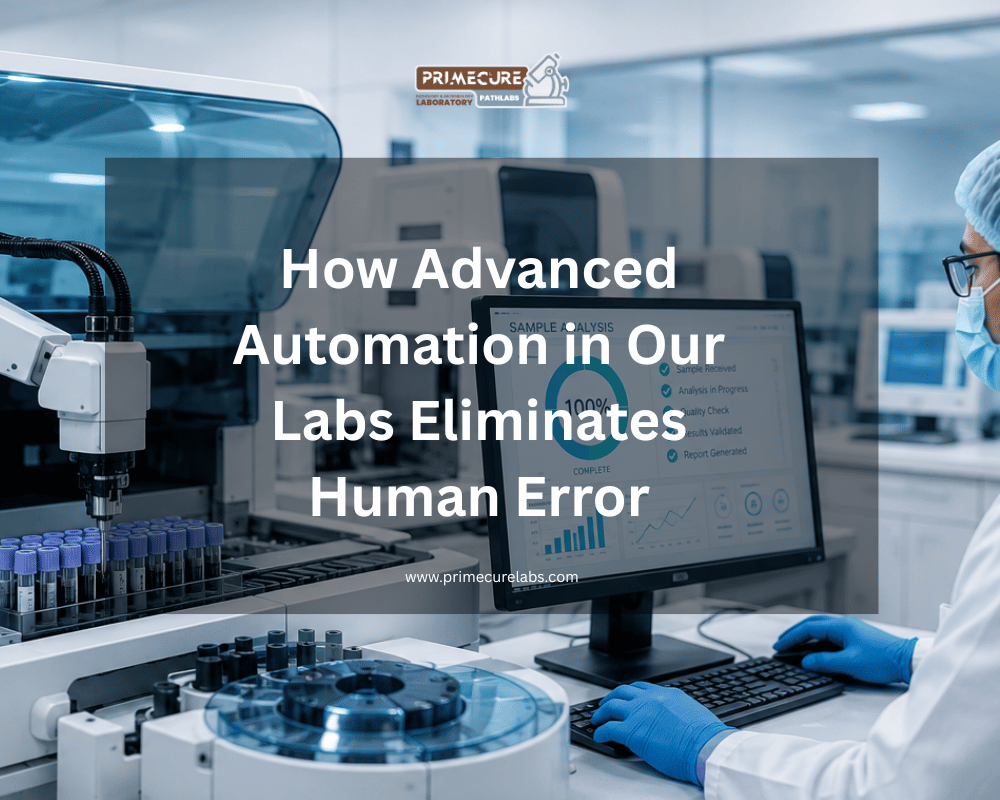
Advanced laboratory automation refers to the use of machines, robotics, and connected software to handle repetitive lab tasks that were once done entirely by hand. This includes sample sorting, pipetting, incubation, reading results, and even flagging abnormal values for a pathologist’s review.
Instead of a technician manually pipetting hundreds of samples a day, an automated analyzer performs the same task with consistent precision every single time. This is the foundation of modern medical lab technology, and it is quickly becoming the standard across advanced diagnostic services in India.
How Human Error Enters a Traditional Lab
To understand why automation matters, it helps to know where mistakes typically happen in a manual workflow.
- Sample mix ups. When labels are applied by hand, a rushed morning can lead to two samples being swapped.
- Inconsistent pipetting. A technician’s hand may add slightly more or less reagent than the last, which can shift results.
- Manual data entry. Typing results from an instrument screen into a report opens the door to transcription errors.
- Fatigue related lapses. After processing hundreds of samples in a shift, even skilled staff can lose focus for a moment.
None of this reflects poor training. It reflects the natural limits of manual, repetitive work performed at high volume, every single day.
How Automation Removes These Risks
Diagnostic lab automation addresses each of these failure points directly.
Barcode based tracking assigns every sample a unique identifier at collection, so it moves through the entire testing process without needing to be relabeled by hand. This alone accounts for a large share of human error reduction in labs.
Automated analyzers measure reagents and samples using calibrated, machine controlled volumes, so every test runs under the same precise conditions. Results are transferred directly from the instrument to the reporting system, removing the need for manual data entry altogether.
Pro tip for patients: when you see a report generated with digital, instrument linked results rather than handwritten values, that is usually a sign of a lab running on automated lab testing systems.
Manual Testing vs Automated Testing
The table below breaks down the practical differences patients and doctors actually care about.
| Factor | Manual Testing | Automated Testing |
| Sample identification | Handwritten or manual labels | Barcode tracked from collection to report |
| Reagent measurement | Technician dependent | Machine calibrated, consistent every time |
| Data entry | Typed manually from instrument | Transferred digitally, no re typing |
| Turnaround time | Slower, dependent on staff volume | Faster, parallel processing of samples |
| Error rate | Higher, tied to fatigue and volume | Lower, consistent regardless of volume |
| Scalability | Limited by staff hours | High, machines run continuously |
The pattern here is simple. Automation does not replace the pathologist’s expertise, it removes the repetitive manual steps where mistakes are most likely to creep in, so accurate lab results are the norm rather than the exception.
Why This Matters for Patients in Ahmedabad
For patients across Ahmedabad and the wider Nikol area, this shift has a direct, practical impact. A NABL accredited automated lab in Ahmedabad follows strict quality protocols on top of automation, meaning both the process and the equipment are independently verified.
Consider a common scenario. A patient books a full body checkup with automated blood testing and gets results the same day, without a technician manually keying in dozens of separate values. The chances of a transcription mistake affecting the report drop significantly, and the doctor reviewing the results can trust the numbers reflect what actually happened in the sample.
This is why searches for best pathology lab with automation in India and advanced diagnostic lab India have grown steadily, patients are increasingly aware that automation is not a marketing term, it is a genuine quality upgrade.
What to Look For in an Automated Pathology Lab
If you are comparing options for a reliable pathology lab in Ahmedabad, these are the practical signs of real automation rather than just claims on a website.
- NABL or ISO accreditation, confirming quality standards are independently checked.
- Barcode based sample tracking, visible from booking through to report delivery.
- Digital, instrument linked reports rather than manually compiled ones.
- Automated microbiology and hematology systems, which reduce variability in infection and blood related testing.
- Clear turnaround time commitments, since automation should also mean faster results, not just more accurate ones.
Primecure Pathlabs, located in Nikol, Ahmedabad, is one example of a diagnostic centre in Nikol Ahmedabad that has invested in automated microbiology and hematology systems alongside experienced pathologists, combining machine precision with expert clinical review.
Frequently Asked Questions
- How does laboratory automation improve test accuracy?
- Automation standardizes every step, from sample identification to reagent measurement, so results depend on calibrated machines rather than manual technique that can vary from person to person.
- Why is human error reduction important in diagnostic labs?
- Even small errors, like a mislabeled sample or a data entry mistake, can lead to an incorrect diagnosis or a repeated test. Reducing these errors protects both patient safety and treatment decisions.
- Do automated pathology labs still need human pathologists?
- Yes. Automation handles repetitive, high volume tasks, but a qualified pathologist still reviews abnormal results, interprets patterns, and makes the final clinical call.
- Is automated testing more expensive than manual testing?
- Not usually. Automation increases speed and consistency, and most labs price automated tests the same as standard tests, since the efficiency offsets the equipment cost over time.
- What is digital pathology, and is it the same as lab automation?
- Digital pathology specifically refers to digitizing slides and images for remote or AI assisted review, while lab automation covers the broader process of running tests with machines. The two often work together in modern labs.
Conclusion
Human error in diagnostic testing has never been about carelessness, it has been about the natural limits of manual, repetitive work at scale. Lab automation changes that equation entirely, replacing hand labeled samples and manually typed results with barcode tracking, calibrated instruments, and digital reporting.
For patients in Ahmedabad choosing between labs, this difference is worth asking about directly. If you want accurate lab results backed by automated systems and experienced pathologists, book your next test with Primecure Pathlabs and see the difference automation makes in your report.

Dr. Sneha Dholakiya, M.D. is an experienced Pathologist at Primecure Pathlabs, Ahmedabad. With a strong background in diagnostic pathology and experience at reputed healthcare institutions, she specializes in providing accurate and timely diagnostic insights, helping patients and healthcare providers make informed medical decisions.